
/ The Pirate Funnel (AARRR) Is Missing Two Stages
Monthly Active Users (MAU) is the selfie angle of app metrics: flattering, familiar, and carefully framed. It tells you how many people turned up last month, which is worth knowing, but it will not tell you why they turned up, which part of your growth is doing the actual work, or what would happen if you changed something. A flat MAU line can mean a stable business or it can mean new installs replacing the people slipping out the back, and from the outside those two look identical.
The real story lives in your funnel: the sequence of stages a customer moves through with your product, with a conversion number on each step so you can see how many people make it from one to the next.
What is the Pirate Funnel (AARRR)?
The best-known version in mobile is the Pirate Funnel, AARRR, named after the noise a pirate makes. It was introduced in 2007 by Silicon Valley investor Dave McClure in a talk called Startup Metrics for Pirates, and has since worked its way well beyond startups into banks, retailers and airlines. Five stages:
- Acquisition. Someone decides to download. Your store page is the shop window, and the decision usually takes seconds.
- Activation. The first real win inside the app, where your promise proves itself and the user thinks, right, this works.
- Retention. Whether the app earns a place in someone's routine, or joins the folder on page four.
- Revenue. The point at which the value delivered is worth paying for.
- Referral. The experience is good enough that people bring others in, usually without being asked.
It is a genuinely useful model, and many of my teams have run on it. But the roar is a bit short in practice, because it starts at the download and stops at the recommendation, and a customer's life with your product is longer than that at both ends.
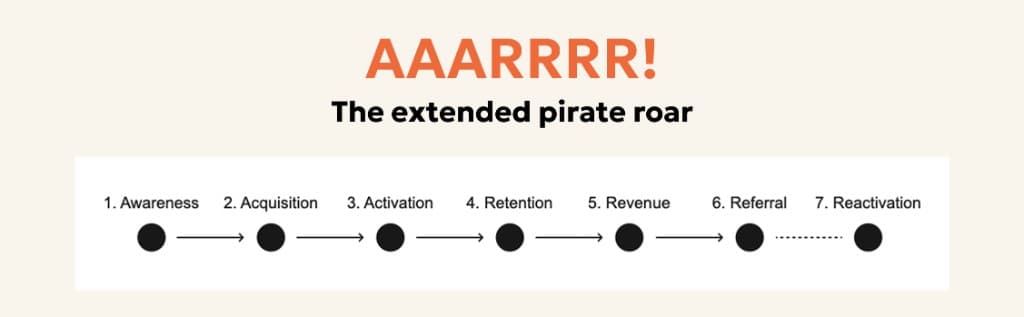
So I let it rip a little longer. An A for Awareness goes at the front, covering everything that happens before anyone downloads, and an R for Reactivation goes at the back, covering the people who have already left. AAARRRR: Awareness, Acquisition, Activation, Retention, Revenue, Referral, Reactivation.
Both stages tend to be missing from the diagram. Awareness happens out in the world where attribution is messy, and in many tools and dashboards a churned user is not a user anymore. Nobody argues against these stages. They just never end up on anyone's chart.
Awareness: the part where you are not asking for anything
Awareness is everything before acquisition, and the distinction that matters is that you are not pushing for a download yet. Visibility, PR, search presence, being talked about. You are trying to be there when the thought first forms, which is earlier than most acquisition budgets assume.
It helps to remember that the people you reach here are in different states. Some are at an inflection point, one of those moments when life shifts enough that old habits come up for review: a new job, a new home, a first client. Others have the problem but have never considered that a solution exists that might solve it. And some have no idea this category of product exists at all. Each of those needs a different message, and none of them responds well to being asked to install something immediately.
With Albert, the bookkeeping app we founded and later sold to Santander, this became obvious once we stopped thinking about bookkeeping. Nobody wakes up wanting accounting software. What actually happens is that somebody goes freelance and, a few weeks in, has to send their first invoice with no idea how it should look or what legally has to be on it. So we went after “how to send an invoice” and “what has to be on an invoice” in Google and in the App Store, and met people at the moment the problem became real, rather than bidding against everyone else for “bookkeeping app”.
Reactivation: the users you have already paid for
At the other end sits the stage that is often ignored. You have already spent the money to acquire these people, they know what your app does, and plenty of them left for reasons that had nothing to do with your product. According to RevenueCat's State of Subscription Apps research, apps can win back around 10% of ex-subscribers within a year, which is far too much to leave on the table.
Not everyone who left is equally gone, though, and the three groups want quite different treatment. Silent users have been away for days or weeks, and they are the easy win, where a reminder of something waiting for them in the app beats any discount. Dormant users have been away long enough that the need itself has faded, so they need a genuine reason to look again, a significant update or a real offer. Inactive users are the hardest, and there I would not hold back on deep discounts or lifetime deals. Effort and offer both rise as the absence lengthens.
Duolingo does this better than almost anyone, and the interesting part is not just the timing of the notifications. The messages sit on loss aversion, a streak you are about to lose, delivered by a character with enough personality that you forgive it for nagging you. You feel reminded rather than sold to. That is a psychological decision more than a CRM one, and it is the part most teams skip when they copy the tactic. It also carries an unglamorous requirement: you need channels that survive the app being forgotten or deleted. Push notifications often do not. Email, SMS and WhatsApp do.
For sharper thinking on what makes products succeed,follow me on
Why bother mapping any of it
Because stage-to-stage numbers stop you guessing. Say 50,000 people become aware of your app, 10,000 download it, 3,000 complete the first key action, 1,800 come back and 180 pay. Those drop-offs look brutal and they are broadly normal, with RevenueCat putting the average across industries at around 1.7% of downloads converting to paying subscribers in the first 30 days. Now improve one step: lift activation from 30% to 60% with a better sign-up flow, hold everything else constant, and paying customers go from 180 to 360.
There is another benefit too, which is that a shared funnel rallies a team. Product managers, designers, engineers and marketers looking at the same picture and owning the same numbers, rather than each polishing their own corner and calling it progress. The best mobile teams I have worked in checked theirs daily, on dashboards anyone could glance at without asking permission. It is not the only compass for a team, but an important one.
If you want somewhere to start, ask who owns awareness and reactivation. If the answer takes more than five seconds, you have found an opportunity to improve.
The question I could not answer
I was slow to add these two stages myself. For years I ran the standard five and felt quite pleased about how rigorously we optimised them, until someone on the team asked me something I had no answer to: how many of the people who left last year came back, and how many did we actually ask? We had no idea. It had never been on a chart, so it had never been a conversation.
That is the thing about frameworks. They are useful precisely because they narrow your attention, and that narrowing is also what makes them dangerous, because after a while you stop seeing what sits outside the frame. The habit worth keeping is asking, every so often, not how to improve the numbers you are looking at, but what is not on the chart at all.
The extended pirate funnel is part of Level 3 of the Mobile Mindset framework. The full treatment, with 25+ case studies, is in Pocket Winners.

About the author
Hi, I'm Ivo. Mobile & AI Product Leader, Exited Founder, Best-Selling Author and Early-Stage Investor. Over 20 years, I've created and shipped successful, high-growth products used by millions of people. For startups, scale-ups, and enterprises. Recently I have been leading the first AI-powered education apps for schools worldwide.